A larger display comes standard.
Tucson includes a 12.3-inch center touchscreen across its gas trims. The 2026 CR-V uses a 9-inch screen throughout the lineup. Try the menus you use most from your normal driving position.1,2
2026 SUV comparison
For daily family duty, Tucson brings a larger standard center screen, more published passenger volume in gas models and higher rated output when you compare the hybrids. Longer basic and original-owner powertrain coverage adds another practical reason to consider Hyundai.1,2,3,4,5
Hyundai Tucson
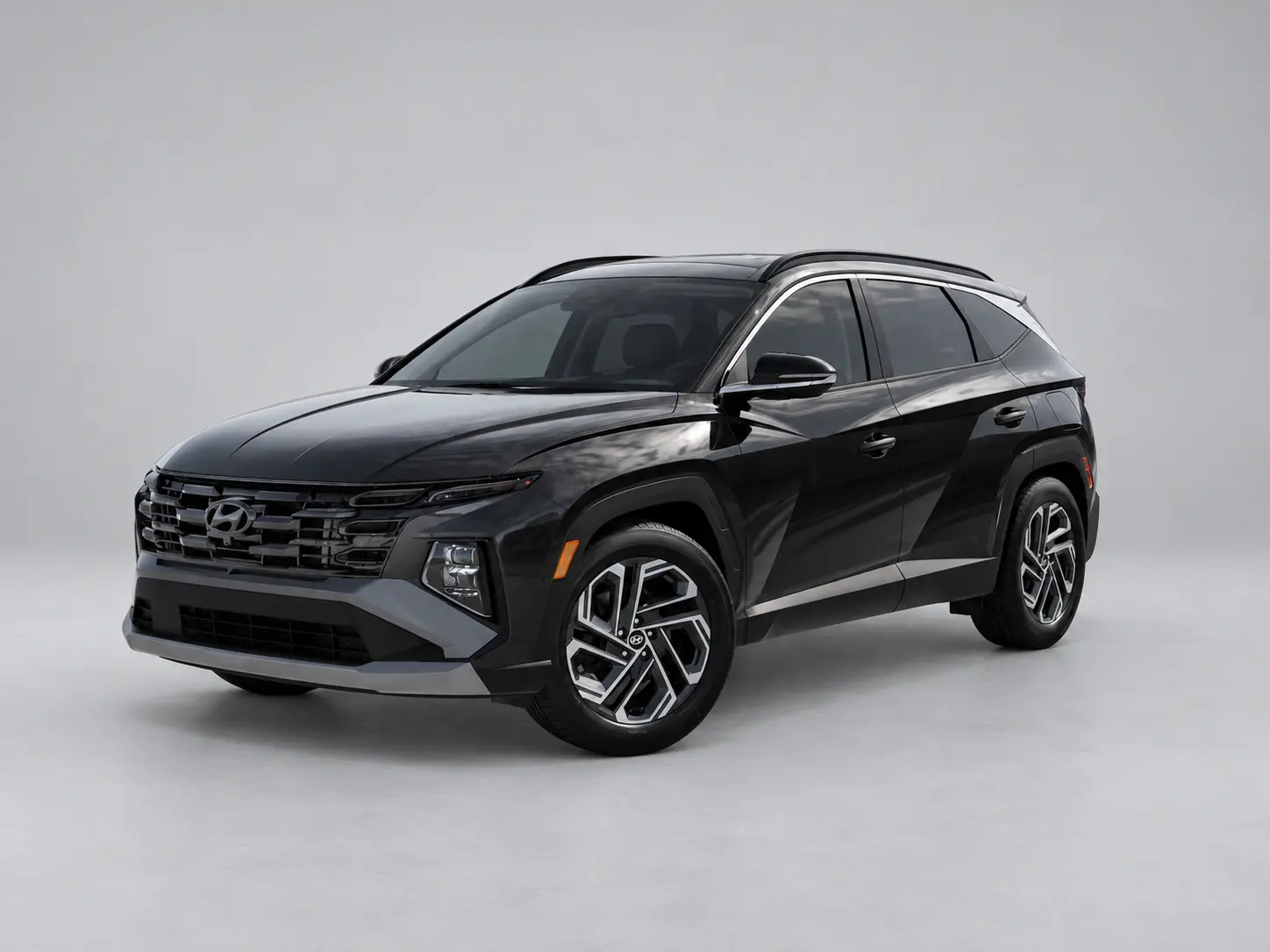
The details make the daily difference.
Consider the Tucson
Choose your powertrain first, then compare the space, controls and coverage attached to that configuration. A gas-model advantage does not automatically apply to a hybrid.
Tucson includes a 12.3-inch center touchscreen across its gas trims. The 2026 CR-V uses a 9-inch screen throughout the lineup. Try the menus you use most from your normal driving position.1,2
Gas Tucson lists 108.2 cubic feet of passenger volume. CR-V LX lists 106.0, with other trims at 103.5. Whole-cabin volume does not make every seat dimension larger. Check headroom and rear-seat access with your usual passengers.1,2
Tucson Hybrid produces 231 combined horsepower, compared with 204 total system horsepower in CR-V Hybrid. That is 27 more rated horsepower. It does not establish acceleration, towing or fuel-economy superiority; it gives you one useful specification to assess during a drive.2,3
Hyundai’s new vehicle warranty runs 5 years/60,000 miles, compared with Honda’s 3 years/36,000 miles. Hyundai also covers the original owner’s powertrain for 10 years/100,000 miles; Honda’s powertrain coverage is 5 years/60,000 miles. Read the coverage details alongside the equipment list.*4,5
Compare the details
U.S. 2026 models. Space figures below describe gas Tucson and gas CR-V; the horsepower row explicitly compares Hybrid versions.
Swipe the table to compare both vehicles.
| What matters to you | 2026 Hyundai Tucson | 2026 Honda CR-V |
|---|---|---|
| Standard center touchscreen1,2 | 12.3 inches | 9 inches |
| Passenger volume1,2 | 108.2 cu. ft.Gas models. | 106.0 / 103.5 cu. ft.LX / other gas trims. |
| Rear legroom1,2 | 41.3 inchesGas Tucson. | 41.0 inches |
| Hybrid system output2,3 | 231 hpTucson Hybrid only. | 204 hpCR-V Hybrid only. |
| Published cargo behind second row1,2 | 38.7 cu. ft. SAEGas model; Hyundai also lists 41.2 maximum. | 39.3 cu. ft.Gas LX, EX and EX-L. |
| New vehicle limited warranty*4,5 | 5 years / 60,000 miles | 3 years / 36,000 miles |
| Powertrain limited warranty*4,5 | 10 years / 100,000 milesOriginal owner. | 5 years / 60,000 miles |
Warranty periods end at the stated time or mileage, whichever comes first. Limitations and exclusions apply. Hyundai’s 10-year/100,000-mile Powertrain Limited Warranty is for the original owner; subsequent owners receive remaining applicable 5-year/60,000-mile New Vehicle Limited Warranty coverage. Commercial-use exclusions apply. These comparisons concern basic/new vehicle and powertrain coverage, not every warranty category. See the manufacturers’ complete terms.4,5
Hyundai publishes maximum and SAE cargo values. We identify its SAE figure instead of treating a differently measured maximum as a cargo win. Honda’s gas and hybrid cargo volumes differ. Passenger volume is a whole-cabin measurement; seat fit still depends on individual dimensions and adjustment.1,2
EPA estimates apply only to the named U.S. 2026 trims and drivetrains. Actual mileage varies with equipment, conditions, driving habits and vehicle condition.2,3
Your next step, at Weimer
Morgantown and Clarksburg shoppers can make this comparison useful by choosing a gas or hybrid Tucson first, then checking the exact trim’s passenger layout and equipment. Ask our team to walk through the features you will use every week.
Try a rear-facing child seat or your usual luggage if either is part of the routine. On the drive, compare the controls and seating position before deciding whether the hybrid’s driving feel suits you.
Explore current Hyundai offersStart with current inventory, or make time to experience it in person.
Browse Tucson inventoryQuestions? Call 304-983-2277 or contact us.
Before you decide
The stated advantage is Hybrid versus Hybrid: 231 hp for Tucson Hybrid and 204 hp for CR-V Hybrid. Gas Tucson produces 187 hp, while gas CR-V produces 190 hp. Keep those comparisons separate when selecting an engine.1,2,3
There is no blanket cargo-win claim here. Hyundai publishes both maximum and SAE figures, and Honda’s figures change with powertrain. The table shows gas Tucson at 38.7 SAE cubic feet behind the rear seat and gas CR-V at 39.3 published cubic feet.1,2
For the highest-rated versions, CR-V Sport Hybrid and Sport-L Hybrid FWD reach 40 combined mpg, while Tucson Hybrid reaches 38. AWD and other trims change the result. Compare the specific configurations and remember that actual mileage varies.2,3
U.S. 2026 information checked November 15, 2026. Gas-model space figures and Hybrid power figures are labeled separately. The 27-hp difference is calculated from manufacturers’ system ratings. No acceleration or cargo-method equivalence is implied.