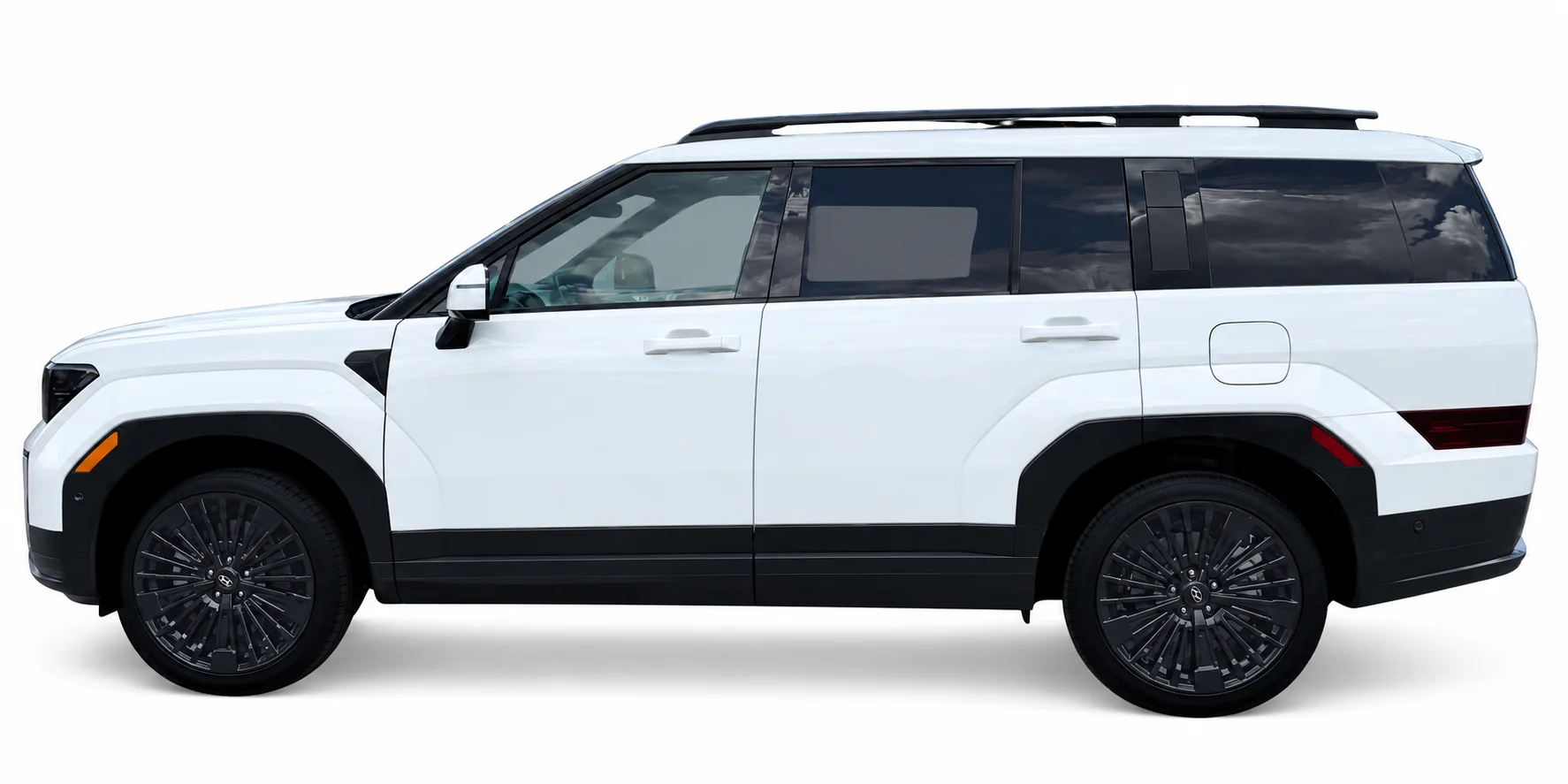
Why choose the Hyundai Santa Fe over the Volkswagen Atlas?
Santa Fe deserves a place beside Atlas on a three-row SUV shortlist when you value turbocharged torque, a hybrid alternative and longer new-vehicle coverage. Both can seat up to seven. The Atlas has more published maximum cargo space, so this comparison helps you decide which priorities matter most before choosing a vehicle.1,2,3,4,5
Illustrative vehicle. Features vary by model year and trim.
311 lb-ftSanta Fe 2.5-liter turbo gas-engine torque.1
Up to 7 passengersThree-row seating; select configurations seat 6.2
5 years / 60,000 milesNew Vehicle Limited Warranty.*4
Consider the Santa Fe
Four reasons to explore Santa Fe alongside Atlas.
A useful three-row comparison weighs the engine, seating arrangement and ownership plan together with cargo capacity.
01 / Turbocharged torque
Compare more than the horsepower number.
The gas Santa Fe’s 2.5-liter turbo engine produces 311 lb-ft of torque, compared with Atlas’s 258. Atlas has slightly more horsepower, 282 versus 277. These describe different aspects of engine output. Try Santa Fe’s response for yourself; torque alone does not establish towing capacity or acceleration.1,3
02 / Hybrid alternative
Keep a hybrid on the table.
The 2026 Santa Fe family includes a separate hybrid powertrain; the U.S. 2027 Atlas uses a turbocharged gas engine. If you want a hybrid three-row SUV, Santa Fe supplies that option. Review its specifications separately from the 2.5-liter gas figures here.2,3
03 / Seating flexibility
Choose a cabin arrangement for your passengers.
Santa Fe seats up to seven, or six in select configurations with second-row captain’s chairs. Atlas also accommodates up to seven. Explore Santa Fe’s bench and captain’s-chair layouts to see how your family uses the middle and third rows; the maximum passenger count alone cannot answer that.1,2,3
04 / Longer coverage
Look at the ownership horizon.
Santa Fe includes Hyundai’s 5-year/60,000-mile New Vehicle Limited Warranty, compared with Volkswagen’s 4-year/50,000-mile term. Original Hyundai owners also receive 10-year/100,000-mile Powertrain Limited Warranty coverage. Those are specific ownership benefits to weigh if you expect to keep your SUV beyond the first few years, subject to the applicable conditions.*4,5
Compare the details
The three-row comparison in detail.
U.S. 2026 gas Santa Fe versus the redesigned U.S. 2027 Volkswagen Atlas. The separate Santa Fe Hybrid is identified as a lineup option; hybrid output is not mixed into the gas-engine rows.
Swipe the table to compare both vehicles.
Manufacturer-published specifications. Equipment varies by model year, trim and powertrain.
*Time or mileage limit, whichever comes first, where applicable. Limitations and exclusions apply. Hyundai’s 10-year/100,000-mile powertrain coverage applies to original owners; subsequent owners receive remaining applicable 5-year/60,000-mile New Vehicle Limited Warranty coverage. Roadside assistance is separate from repair coverage.4,5
Maximum cargo space is measured with both rear rows folded, so it cannot be used while carrying the maximum passenger count. Published manufacturer methods can vary. Engine torque is not a substitute for the vehicle’s towing rating.1,3
Your next step, at Weimer
Experience the Santa Fe in Morgantown.
Shopping from Morgantown, Fairmont or Clarksburg? Use a Santa Fe visit to test the seating arrangement your household needs, then check the space for the bags that travel with those passengers. That is more useful than comparing maximum cargo numbers alone.
Try the third-row access and fold the seats you would normally fold. If you are considering the hybrid, drive that version separately and confirm its equipment instead of assuming it matches the gas trim.
Does Santa Fe have more room for cargo than Atlas?
Not on the maximum-volume measure shown here. The 2027 Atlas publishes 95.4 cubic feet with both rear rows down; the 2026 Santa Fe lists 79.6. Compare your actual load and passenger arrangement, because maximum volume requires folding the seats that passengers would otherwise occupy.1,3
Does more Santa Fe torque mean it can tow more?
No. Santa Fe’s listed gas-engine torque is 311 lb-ft versus Atlas’s 258, but torque alone does not determine towing capacity. Towing depends on the vehicle’s rating, equipment and operating limits. Confirm those separately for the precise trim and trailer you plan to use.1,3
Can I compare a Santa Fe Hybrid using this table?
The hybrid is a separate option with its own specifications. This table’s horsepower and torque rows describe Santa Fe’s 2.5-liter turbo gas engine. Review the hybrid’s specifications separately before choosing a powertrain.1,2
Keep comparing
More Santa Fe comparisons.
Sources & comparison notes
U.S. 2026 Hyundai Santa Fe and 2027 Volkswagen Atlas information checked November 15, 2026. Atlas figures describe the redesigned 2027 model. Gas powertrain figures only unless expressly identified. Seating and equipment vary by trim; confirm the configuration you choose.